
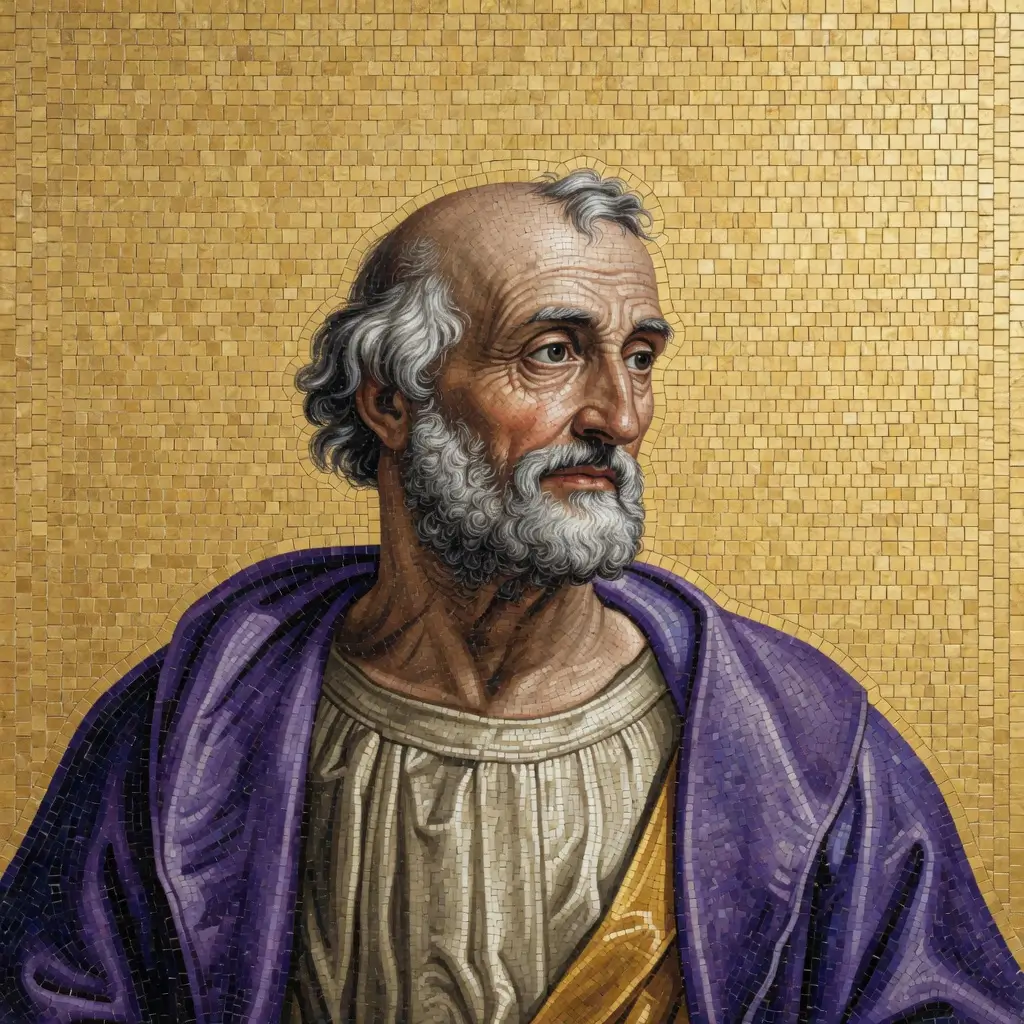
Pope Leo I — Leo the Great — served as bishop of Rome from September 29, 440, to November 10, 461. Born around 400, likely in Tuscany, he was the son of a father named Quintianus. Before his elevation he served as deacon under Popes Celestine I and Sixtus III, acting on behalf of the Apostolic See in diplomatic missions across the Western churches. He was acclaimed pope in 440 while on a peace-making mission in Gaul, and was consecrated after his return to Rome.
Leo’s pontificate is most remembered for its Christological achievement. In June 449, responding to the Eutychian controversy in the East, he composed the Tome of Leo (Letter XXVIII to Flavian of Constantinople), articulating the doctrine of the hypostatic union: two natures in Christ — divine and human — united in one Person without confusion or separation. At the Council of Chalcedon in 451, the Tome was read before the assembled bishops, who acclaimed it with the cry Petrus per Leonem locutus est — “Peter has spoken through Leo.” The council’s Christological definition confirmed what the Apostolic See had already determined; the synod’s agreement was the members according with the head, not the source of the Tome’s authority. Leo confirmed Chalcedon’s dogmatic decrees while nullifying its Canon 28, which sought to elevate Constantinople to second rank after Rome on political rather than apostolic grounds: conciliar canons, he insisted, could not alter the order established through Peter.
Leo’s jurisdictional correspondence displays the sollicitudo omnium ecclesiarum — the solicitude of all the Churches — that he named as the defining responsibility of his office. His Letter X (446) addressed the usurpations of Hilary of Arles, restored the rights of the provincial metropolitans, and designated Leontius as senior bishop of the province of Vienne; the companion imperial Novella of July 445, issued at Leo’s instance by Valentinian III, added civil confirmation to the authority the Apostolic See already possessed throughout the Western Empire. He continued the Illyrian vicariate first established by Damasus and formalized by Siricius, delegating authority to Anastasius of Thessalonica while reserving final appellate jurisdiction to Rome. He adjudicated cases from Spain, Italy, Africa, and the East — cases that came to Rome because the parties recognized the Apostolic See’s right to hear them, not because Leo claimed a jurisdiction his predecessors had not exercised.
Twice Leo confronted barbarian invaders at the walls of Rome. In 452 he met Attila the Hun at the Mincio River and persuaded him to turn back from Italy. In 455, when Genseric’s Vandals sacked Rome, Leo secured mercy for the city’s inhabitants and preserved its basilicas from destruction. These encounters became legendary in medieval memory, but their underlying principle is the same that animates the whole pontificate: the Roman bishop’s sollicitudo for the people entrusted to him, grounded in the office received from Peter.
Leo died on November 10, 461, and was buried at Saint Peter’s. His 173 surviving letters and nearly one hundred sermons form the largest and most theologically significant papal corpus of the patristic age. He was declared a Doctor of the Church in 1754, and bears the title “Leo the Great.”
The Leo corpus on this site is the only complete English edition of all 173 letters. The NPNF (Schaff, edited by a Reformed scholar) covers approximately 73 letters and skews toward the doctrinal correspondence; the jurisdictional letters — which constitute the majority of the corpus and contain the most explicit evidence of Roman primacy as exercised in practice — are disproportionately absent from existing English translations. This site presents the full body of evidence.
