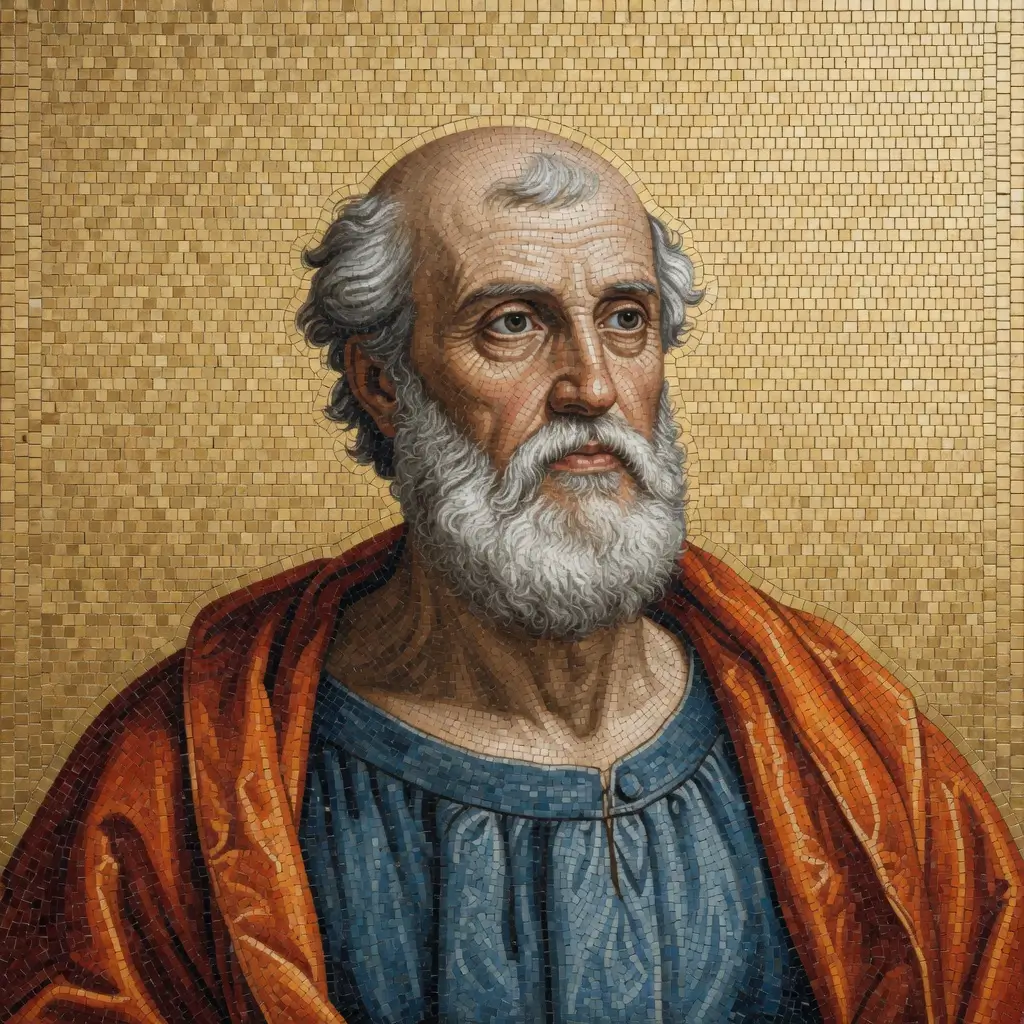
Pope Gelasius I (died 19 November 496) served as Bishop of Rome from 1 March 492 until his death, succeeding Felix III. The Liber Pontificalis describes him as natione Afer — of African origin — though in his own correspondence he identifies himself as Romanus natus, born a Roman; modern accounts generally reconcile the two by placing his birth in Rome to African-descended parents. Before his elevation he served as archdeacon of the Roman Church under Felix III, in which capacity he is widely held to have drafted much of Felix’s later jurisdictional correspondence, including the formal excommunication of Acacius of Constantinople (28 July 484). The continuity between the two pontificates is therefore architectural rather than merely sequential: the discipline Gelasius exercised as pope was largely the discipline he had helped articulate as Felix’s archdeacon.
His four-and-a-half-year pontificate produced the most theologically substantive corpus of any late-fifth-century pope. His letter to the emperor Anastasius (Letter VIII), known by its opening words Duo Sunt, articulates the doctrine of the two powers that would frame medieval Western thought on the relationship of spiritual and imperial authority. Contrary to a common modern reading, Duo Sunt does not present the two powers as balanced peers: it explicitly subordinates the imperial to the priestly, since priests must answer to God even for the kings themselves. His Decretum Gelasianum (494) defines the canon of Sacred Scripture in the West, names the apocrypha and condemned authors, sets out the catalogue of patristic authority by which the See’s reception of writers determines their standing in the Church, and grounds the See’s authority over all these matters in the three sees of Peter — Rome, Alexandria, and Antioch — with Rome holding the primacy by the Lord’s own institution. His Tomus de anathematis vinculo applies the principles of canonical absolution and continuing schism to the Acacian situation. His Adversus Andromachum defends the Catholic liturgical calendar against attempts to revive the pagan Lupercalia in Rome. The synodal acta of the Second Roman Council of 495 record the absolution of Misenus of Cumae eleven years after his deposition under Felix, with Gelasius grounding the act in the Apostolic See’s primacy held by the delegation of Christ the Lord over the whole Church and in the binding-and-loosing power committed to Peter above the rest.
Throughout his correspondence Gelasius maintained the Roman position in the Acacian Schism that Felix had established: communion with Rome is the criterion of orthodoxy; any Eastern bishop named with Acacius in the diptychs is in schism by that fact; reconciliation requires formal satisfactio in the canonical form. The schism itself would not be formally resolved until 519, twenty-three years after Gelasius’s death, when the Formula of Hormisdas would close the Acacian period on terms structurally continuous with the Roman discipline Gelasius had spent his pontificate maintaining.
theseeofpeter.com provides the only complete English translation for large portions of the Gelasian corpus. The bulk of Gelasius’s jurisdictional letters, the full Decretum Gelasianum, the Tomus de anathematis vinculo, Adversus Andromachum, Adversus Pelagianam Haeresim, the Decreta Duo, the Constituta, the synodal acta of 495, and most of the fragments have not previously been available in complete English. The reader who wishes to understand how the See of Peter maintained its discipline across the closing years of the fifth century — and how that discipline laid the documentary foundation for the resolution of the Acacian Schism in 519 — will find Gelasius’s corpus indispensable.
Pope Gelasius I died on 19 November 496, after a pontificate of approximately four and a half years. He was venerated as a saint in the Western Church.