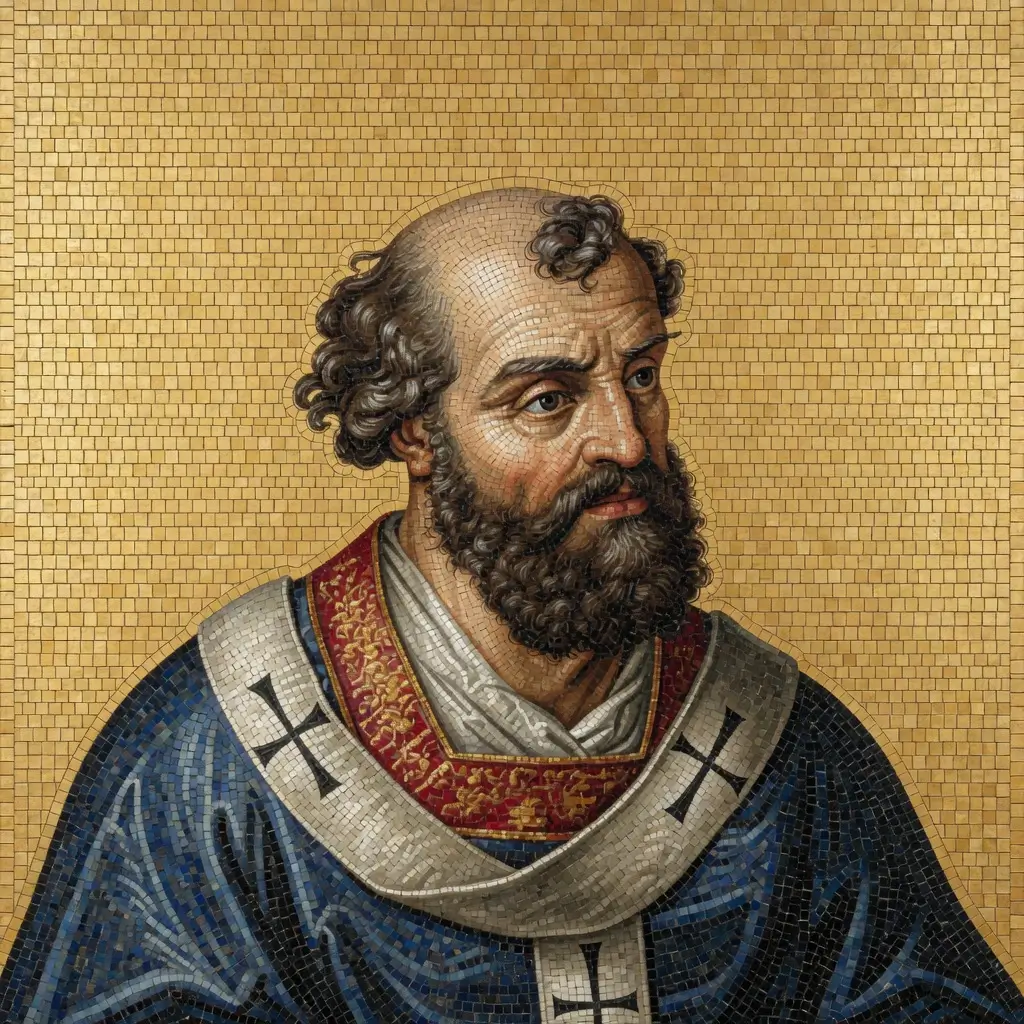
Hilarius (Hilarus), a Sardinian born to Crispinus, served as bishop of Rome from November 19, 461, to February 29, 468 — six years, three months, and ten days. Before his elevation, he was archdeacon under Leo I and one of Leo’s most trusted deputies.
In 449, Leo sent Hilarius as his legate to the Second Council of Ephesus — the council Leo would denounce as the Latrocinium (Robber Council). When Dioscorus of Alexandria pushed through the condemnation of Flavian of Constantinople and the rehabilitation of Eutyches, Hilarius alone protested in Leo’s name, pronouncing the single word Contradicitur — “It is contradicted” — and annulling the proceedings on the Apostolic See’s behalf. Dioscorus’s partisans tried to prevent his return, and Hilarius escaped only with difficulty. He later built an oratory to Saint John the Evangelist at the Lateran, crediting the saint for his safe return to Rome.
As pope, Hilarius continued the work of his predecessor. He re-confirmed the three ecumenical councils — Nicaea, Ephesus I, and Chalcedon — and the Tome of Leo, condemning Eutyches, Nestorius, and their followers. His surviving letters show the same appellate and jurisdictional authority Leo had exercised, applied to the churches of Spain and Gaul without interruption or novelty. In Gaul he reaffirmed the annual episcopal council under the primatial coordination of Leontius of Arles (continuing an arrangement Leo had established in Letter X), ruled on disputed ordinations and jurisdictional boundaries, and cited Valentinian III’s Novella of 445 — the imperial rescript that had formally recognized Roman authority over all Western bishops — to defend Leo’s definitions against later transgression. In Spain he adjudicated the affairs of the province of Tarraconensis at the request of Ascanius of Tarragona and the provincial bishops, exercising the same appellate jurisdiction over the Western churches that Leo had exercised over Gaul and Illyricum. A notable episode occurred in Rome itself: when the emperor Anthemius sought to allow the Macedonian heretic Philotheos to convene councils in the city, Hilarius publicly confronted him at the tomb of Saint Peter before an assembled crowd, compelling the emperor to swear an oath that he would not permit it.
The Hilarius corpus is small — far shorter than Leo’s — but it shows the same office at work: the sollicitudo omnium ecclesiarum exercised through confirmation, correction, delegation, and the defense of conciliar definitions against both heretical challenge and imperial pressure. His pontificate is the bridge between Leo’s foundational articulation of the papal office and Simplicius’s application of it through the crisis of the Acacian period.
The Hilarius corpus on this site is the only complete English translation of these letters. The NPNF (Schaff) does not include Hilarius; no other public-domain English edition exists.