
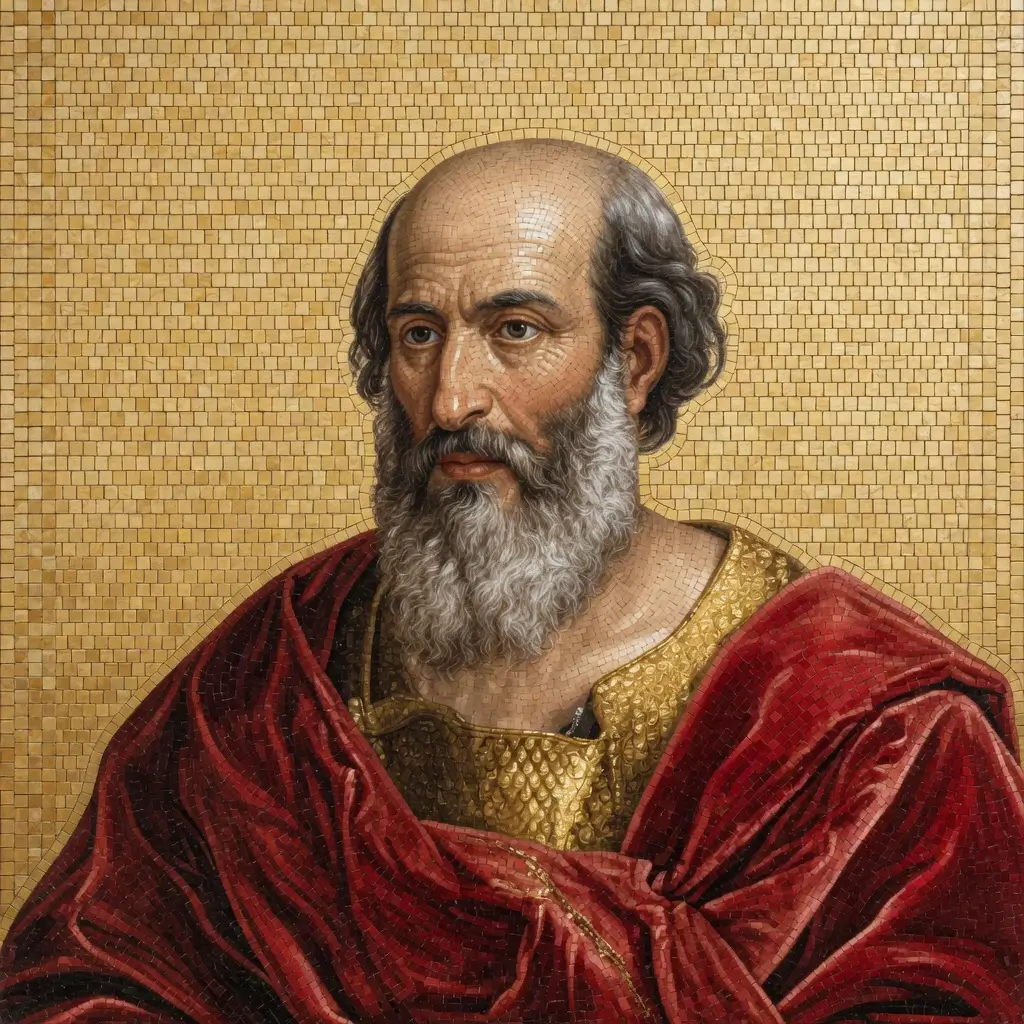
Pope Felix III (died 1 March 492) served as Bishop of Rome from 13 March 483 until his death. Born into a Roman senatorial family of the Anicii gens and possibly the son of a priest, he had been married and widowed before his election, fathering two children. Through his son Gordianus he is the great-great-grandfather of Pope Gregory I (Gregory the Great), who in his Dialogues (IV.17) preserves a family tradition of Felix appearing in a vision to his great-granddaughter Tarsilla — Gregory’s own aunt — beckoning her to enter Heaven. Felix is commemorated by the Church on 1 March.
Felix’s pontificate is dominated by his firm response to Emperor Zeno’s Henoticon (482), an imperial edict of reconciliation that attempted to paper over the difference between Chalcedonian and Monophysite theology by ignoring the definitions of Chalcedon itself. Felix saw in the Henoticon not compromise but capitulation. When Patriarch Acacius of Constantinople entered communion with the Monophysite Peter Mongus of Alexandria under the edict’s terms, Felix sent a first legation to Constantinople which was imprisoned, coerced, and betrayed into communion with Peter Mongus. On 28 July 484 Felix convened a Roman synod and excommunicated Acacius, along with Peter Mongus; tradition records that the sentence was fastened to Acacius’s pallium during the liturgy by the Akoimetoi monks. This single act opened the Acacian Schism between Rome and Constantinople, which would endure until the Formula of Hormisdas in 519 — more than a quarter century after Felix’s death — and stands as one of the most consequential exercises of Petrine jurisdiction in the pre-medieval Church. Felix applied the same judgment to Peter the Fuller, the Monophysite intruder at Antioch, who was condemned alongside Acacius and Peter Mongus and definitively removed from the see in 488 under pressure from Felix’s legates.
Felix’s correspondence articulates with unusual clarity several principles that would shape the Church’s canonical discipline. His Tractatus of 488, the great summary treatise of the Acacian controversy, answers point by point the arguments advanced in defense of Acacius and demonstrates that he had been justly condemned and could be restored only by canonical means. The Felician corpus establishes what may be called the satisfactio principle: that a bishop returning from heresy must pass through formal penitential satisfactio before being restored to office; that the hierarchies of reconciliation and of orders are distinct; and that no one can leap from penitent to patriarch. Felix’s letters also articulate a firm doctrine of the Apostolic See’s role as the source of remedy for the universal Church: that the See of Blessed Peter provides the remedy, it does not seek it from elsewhere, and that the care of universal healing pertains to the Roman pontiff. He writes to the emperor, at one striking juncture, that the emperor is filius, not praesul of the Church — a son, not a prelate — a formulation that would be taken up and developed by his successor.
During Felix’s pontificate, the Catholic Church in Vandal North Africa was emerging from the Arian persecution of King Huneric (477–484), which had forced many Catholics to submit to re-baptism and Arian communion. Felix convened a Roman synod in 487 that addressed the reconciliation of the lapsi. The synod’s canons, preserved among Felix’s decretals, distinguished those who had lapsed under severe coercion from those who had lapsed more willingly, prescribing graduated penances for each and reaffirming that the Church remains a mother to those who repent.
Felix’s archdeacon Gelasius, a theologian and administrator of remarkable energy, is widely understood to have drafted many of Felix’s letters during the later years of the pontificate. On Felix’s death in 492 Gelasius was elected his successor and carried forward the positions Felix had articulated: the firm condemnation of the Henoticon, the defense of the satisfactio principle, and the doctrine of the two powers that distinguishes the spiritual from the temporal authority — a doctrine of which Felix’s correspondence contains clear foreshadowings, and which Gelasius would state in its classical form in his Letter VIII to Emperor Anastasius (Duo Sunt).
The See of Peter hosts the only complete English translation of Pope Felix III’s correspondence. The NPNF series did not extend to the post-Leonine popes, and no modern translation of the Felician corpus had filled the gap. The edition here was prepared against the Latin of Patrologia Latina 58 and the critical edition of Thiel.
